
How to Build a Digital Transformation Strategy and Roadmap That Delivers Real Results
Executive Summary: Digital transformation succeeds when organisations establish clear strategic intent, map capability gaps, and execute with a structured roadmap. This guide outlines the exact process used by leading organisations to reduce operational friction, scale capability, and modernise effectively.
Digital transformation is not a technology project. It is a business imperative — and the organisations that navigate it successfully do so not because they adopted the right tools, but because they built the right strategy first.
A well-defined digital strategy, executed through a structured digital transformation roadmap, is the difference between incremental improvement and genuine competitive advantage. This article sets out what that process looks like, why it matters, and how to approach it with the rigour it demands.
For organisations building long-term digital capability, a structured approach is essential. Learn more about our strategic methodology on our Digital Strategy page.
Who This Is For
Strike Media has spent 14+ years working alongside Australian businesses on digital transformation programs spanning aged care, agriculture, education, professional services, and technology. Across every engagement, the pattern is consistent: organisations that invest in strategy before execution achieve faster results, waste less capital, and build more durable capability.
This guide is written for business leaders and decision-makers who need clarity — not theory — on how digital transformation actually works.
Defining the Terms
Digital Transformation
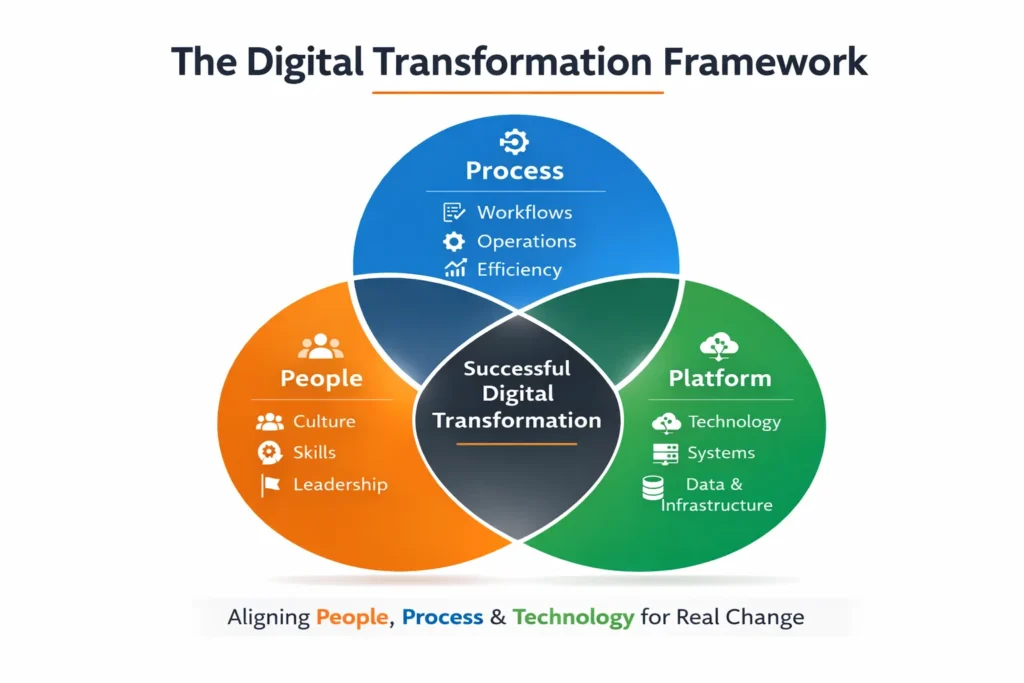
Digital transformation is a fundamental, organisation-wide shift in how a business operates, delivers value, and competes — driven by the strategic application of technology. As Harvard Business Review notes, the biggest obstacle to transformation is not technology adoption but leadership and strategy. It is a change program that touches three dimensions simultaneously:
- People — culture, skills, structure, and capacity
- Process — workflows, methods, and operating models
- Platform — technology, infrastructure, and digital systems
Digital Strategy
A digital strategy is the governing document that defines why transformation is needed, what it must achieve, and how it will be pursued. It connects business objectives to technology decisions — ensuring that every investment, from a new system to a digital marketing program, is directed toward a defined outcome.
Without a strategy, digital initiatives default to opinion, trend, or vendor pressure. With one, every decision has a rationale.
The Digital Transformation Process
The digital transformation process is sequential and deliberate. Skipping steps is the most common cause of expensive failure.
Step 1 — Organisational Assessment
Transformation begins with an honest audit of the current state. This means clarifying strategic goals, identifying operational pain points, and mapping the gap between existing capability and where the business needs to be. This is not a technology review — it is a business health assessment.
Key questions at this stage:
- Where are the inefficiencies costing time and revenue?
- Which processes are limiting growth or customer experience?
- What does the competitive landscape demand over the next three to five years?
Step 2 — Anchoring to Strategic Intent
Before any technology is evaluated, the transformation must be anchored to a clear business rationale. Common drivers include the need to scale operations, improve the customer experience, reduce cost-to-serve, or respond to competitive disruption.
The risk of skipping this step is significant: technology adopted without strategic intent becomes shelfware.
Step 3 — Digital Capability Assessment
Map the organisation's current digital maturity across five domains:
- Technology infrastructure and reliability
- Information systems and data integrity
- Digital marketing capability
- Cybersecurity posture — for Australian businesses, the Australian Cyber Security Centre (ACSC) provides a practical baseline for assessing organisational cyber readiness
- Team digital literacy and adoption readiness
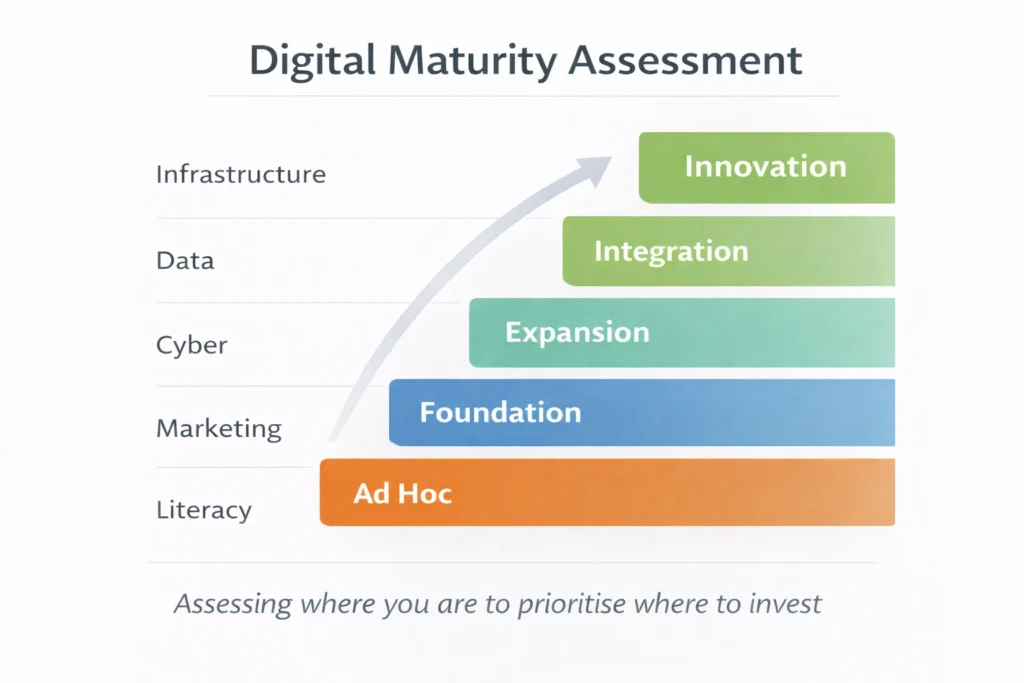
This creates a baseline for prioritisation and investment, and prevents the common mistake of investing in advanced capabilities before foundational ones are stable.
Step 4 — Securing Executive Alignment
The majority of digital transformation failures trace back to insufficient leadership commitment — not technology limitations. Executive sponsorship is not a courtesy; it is a structural requirement.
Leadership alignment ensures that when transformation creates friction (and it will), there is authority and conviction to see initiatives through.
Step 5 — Capability Gap Analysis
With the current state mapped and strategic direction defined, the next step is identifying the specific gaps that stand between the two. For each gap, the response must address all three dimensions: people, process, and platform. A platform solution to a process problem will not resolve the underlying issue.
Step 6 — Initiative Prioritisation
Initiatives should be ranked by impact and implementation effort. High-impact, lower-effort initiatives generate early momentum and prove the model internally. Resource-heavy, longer-horizon initiatives are sequenced once organisational confidence and execution capability have been established.
An impact-effort matrix is a practical tool at this stage — it forces honest trade-offs and prevents scope inflation.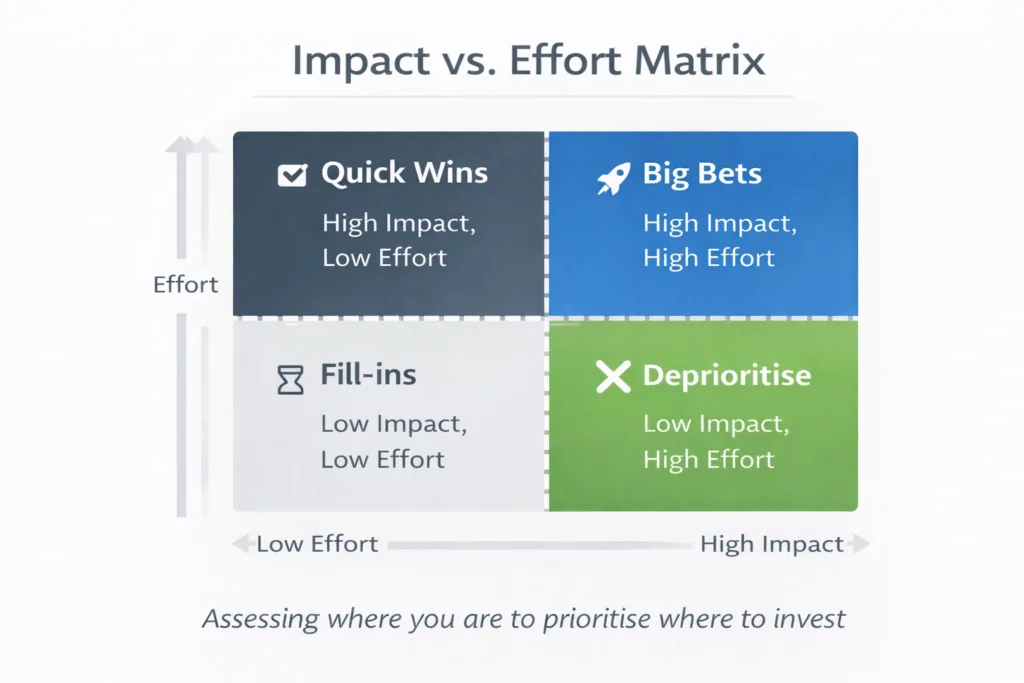
Step 7 — Building the Digital Transformation Roadmap
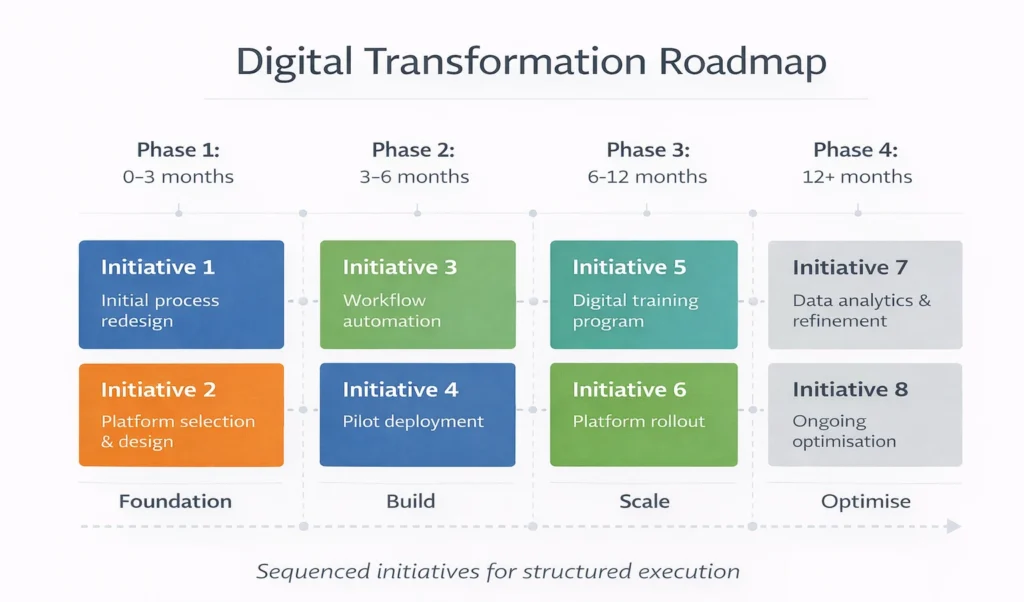
The digital transformation roadmap is where strategy becomes execution. It is a sequenced, time-bound delivery plan that defines:
- What will be delivered, and when
- Who is responsible for each initiative
- What resources and budget are required
- How progress will be measured
A well-constructed roadmap is not a fixed schedule — it is a living document. It provides structure without rigidity, enabling teams to adapt as conditions change without losing strategic direction.
One business that undertook this approach — operating in a highly process-dependent industry — reduced manual operational load by over 60% within 12 months of roadmap execution. The result came not from the technology alone, but from the sequence in which process redesign, team training, and platform deployment were staged.
Step 8 — Engaging the Right Transformation Partner
Internal teams rarely have the bandwidth or breadth of experience to manage large-scale transformation programs alongside their day-to-day responsibilities. Engaging experienced digital strategy consultants provides strategic oversight, technical execution capability, and the organisational accountability that sustains momentum.
The right partner does not just build — they challenge assumptions, identify risk early, and ensure that technology decisions are always subordinate to business outcomes.
Step 9 — Stakeholder Communication
Transformation stalls when people don't understand what is changing or why. A structured communication plan — covering what is changing, the rationale, the timeline, and what it means for each stakeholder group — dramatically improves adoption rates and reduces organisational resistance.
Internal communication is not a soft issue. It is a programme management discipline.
Step 10 — Execution, Measurement, and Iteration
Execution must be paired with measurement from day one. KPIs should be defined before initiatives launch, not after. A test-and-learn approach allows teams to validate assumptions early, surface problems before they compound, and refine the roadmap based on real data rather than projections.
The organisations that sustain transformation are those that treat the roadmap as a guide — not a ceiling.
What a Digital Transformation Roadmap Contains
A roadmap is often mistaken for a project timeline. In practice, it is a strategic alignment tool that answers six questions:
- Why does the transformation need to occur?
- What must the organisation achieve to transform successfully?
- Which areas of the business are in scope?
- What changes are required across people, process, and platform?
- How should changes be grouped into manageable initiatives?
- When and in what sequence should each initiative be executed?
When these questions are answered clearly, the roadmap becomes a single source of truth for leadership, project teams, and transformation partners — aligning effort and preventing the divergence that typically causes programmes to fragment.
Why Digital Transformation Initiatives Fail
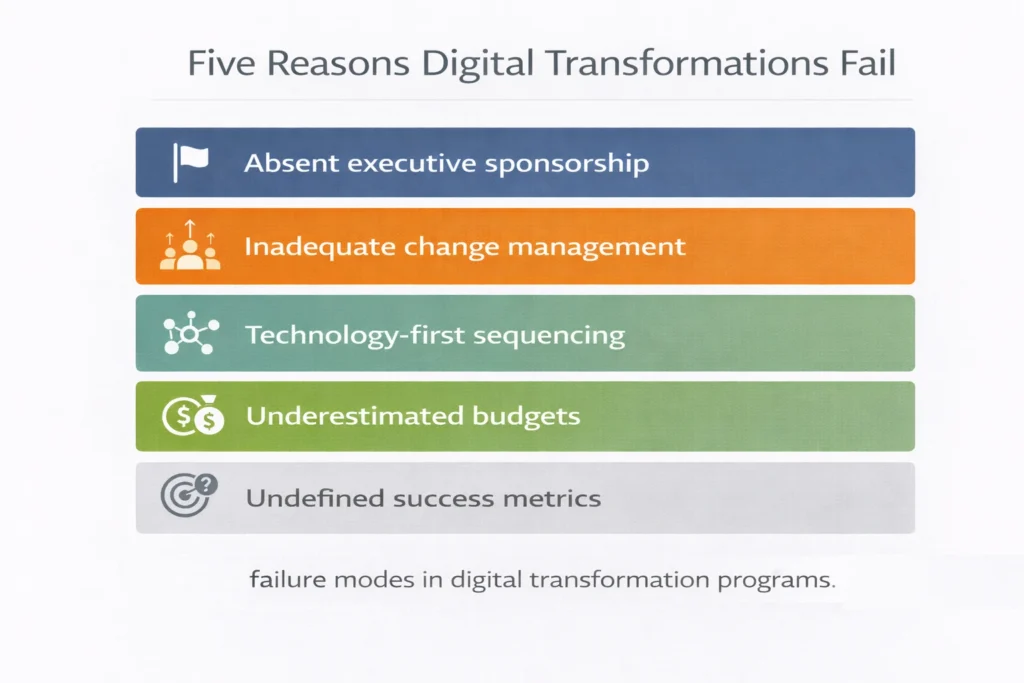
Understanding failure modes is as strategically important as understanding best practice. McKinsey research consistently finds that fewer than one-third of transformation programmes achieve their stated objectives — and the causes are predictable. The five most common:
- Absent executive sponsorship — without committed leadership, transformation loses priority when it creates friction
- Technology-first sequencing — selecting platforms before defining requirements leads to capability mismatches that are expensive to reverse
- Underestimated budgets — transformation programmes consistently exceed initial estimates; plans that don't absorb contingency create compromise
- Inadequate change management — even well-designed systems fail if adoption is not actively managed
- Undefined success metrics — transformation without measurable KPIs becomes directional rather than decisive
A capable digital transformation consultancy will surface these risks during the planning phase — before they become programme-threatening.
Digital Transformation Adelaide: Working With Local Expertise
For businesses based in South Australia, working with digital transformation Adelaide specialists offers a distinct advantage: consultants who understand the local business environment, can engage in person, and have built transformation programmes across the industries that define the region.
Strike Media operates from Adelaide and works with organisations nationally. Our engagements span full digital transformation programs, digital roadmap development, platform builds, and ongoing digital strategy advisory.
For organisations seeking expert guidance to design or execute their digital strategy, explore our Digital Strategy service.
Engage With Confidence
If your business is navigating growth, operational complexity, or increasing competitive pressure, the question is not whether to pursue digital transformation — it is whether you have the strategy and roadmap to do it effectively.
A strategy consultation with Strike Media delivers three immediate outcomes: a clear picture of your current digital capability, an objective assessment of your capability gaps, and a directional roadmap for closing them.
Schedule a complimentary strategy consultation →