
SEO in Australia: What Actually Works in 2026 (From a Adelaide SEO Agency That Ranks Clients #1)
Most SEO content is written by people who don't actually do SEO for a living. They recycle the same generic advice about keywords and meta descriptions while real businesses struggle to get meaningful results. If you're an Australian business looking for SEO that actually drives revenue, you need a framework built on what works in practice, not just in theory.
At Strike Media, we've spent years refining SEO strategies for Australian businesses across industries, from national training providers to competitive service sectors. Based in Adelaide, we've helped businesses across South Australia and nationally achieve sustained rankings and qualified leads. This article shares the exact framework we use to deliver results, along with what's genuinely changed for 2026 and what hasn't.
Why Most SEO Advice Online Fails Australian Businesses
The SEO industry has a credibility problem. Search "SEO tips" and you'll find thousands of articles written for US markets, low-competition niches, or worse, by people who've never ranked anything beyond their own blog. This creates three major issues for Australian businesses:
US-centric strategies don't translate. Most SEO advice is written for American search behaviour, market dynamics, and competitive landscapes.
The Australian market is different. We have higher search costs, different consumer behaviour patterns, and unique local competitors. Strategies that work in oversaturated US markets often miss the mark here, while tactics designed for low-competition spaces fall apart when applied to genuinely competitive Australian sectors.
Report-obsessed agencies game metrics. Many agencies optimise for vanity metrics like traffic and rankings on obscure long-tail keywords rather than business outcomes. They'll celebrate ranking #1 for a term that generates three clicks per month while ignoring the commercial intent keywords that actually drive qualified leads. Australian businesses need SEO that connects to revenue, not just impressive-looking dashboards.
Theory without execution. The gap between knowing what to do and actually doing it well is enormous in SEO. Anyone can read Google's guidelines and understand the concepts. Executing a coordinated strategy across technical infrastructure, content development, authority building, and conversion optimisation requires experience that most content creators simply don't have.
This is why we built our approach from the ground up, based on what consistently works when you're accountable for actual business results.
The SEO Framework We Use at Strike Media
After years of testing, refinement, and real-world application, we've developed what we call the Strike SEO Framework. It's designed around sustainable results rather than quick wins, and it addresses the five areas where most SEO strategies fall apart.
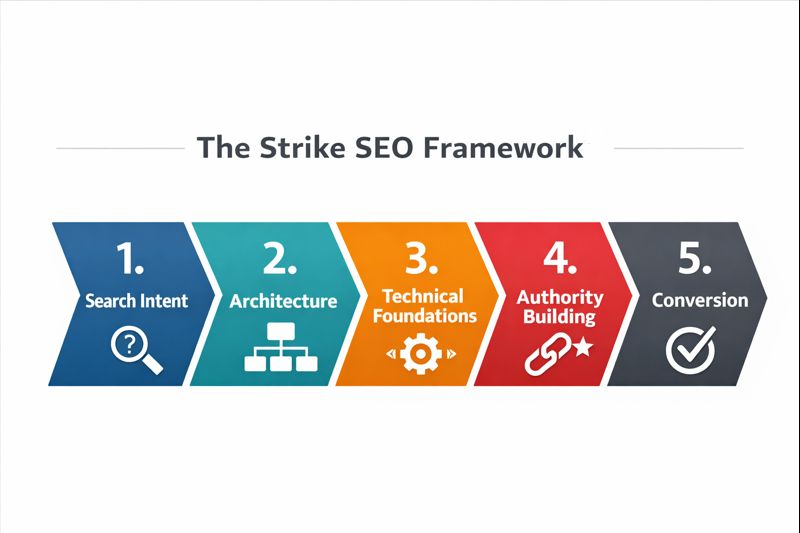
1. Search Intent Mapping (Not Keywords Alone)
Most SEO strategies start with keyword research and stop there. We start by mapping the actual journey your potential customers take. What questions are they asking at each stage? What format do they expect answers in? What underlying problem are they trying to solve? A keyword like "employee training software" could represent someone in research mode, someone ready to buy, or someone trying to solve a specific compliance issue. The content and conversion path need to match that intent precisely.
2. Information Architecture & Internal Linking
Your site structure is one of the most underutilised SEO levers. Most businesses have grown their websites organically over years, creating disconnected pages with no clear hierarchy. We rebuild information architecture so that every page serves a strategic purpose, passes authority effectively through internal linking, and guides users toward conversion actions. This isn't about adding more links to your footer. It's about creating a coherent system that both search engines and humans can navigate intuitively.
3. Technical Foundations (Indexation, Core Web Vitals, Schema)
Technical SEO is where many strategies quietly fail. Pages that can't be indexed don't rank. Sites that load slowly lose rankings and conversions simultaneously. Structured data that's incorrectly implemented can trigger manual penalties. We audit and fix the foundational technical elements first, because no amount of content or links will compensate for a site that Google struggles to crawl and understand. This includes indexation controls, page speed optimisation, mobile usability, and schema markup that actually enhances your search presence.
4. Authority Building (Content + Links)
Authority remains the differentiator between businesses that rank and businesses that don't. Building it requires both demonstrated expertise through content and earned endorsements through backlinks. We create content that actually answers questions your audience is searching for, not just content that targets keywords. And we pursue links from sources that genuinely matter in your industry, not just any site with a decent domain authority score. This combination signals to Google that your site deserves to rank above competitors.
5. Conversion Alignment (SEO That Actually Converts)
The final piece connects SEO to business outcomes. What happens after someone lands on your site from search? We design conversion paths that match search intent, optimise user experience to reduce friction, and ensure that the traffic we generate is actually qualified. An SEO strategy that drives 10,000 visitors who immediately bounce is worse than useless, it wastes budget and distorts your metrics. We focus on attracting and converting the right visitors, not just more visitors.
This framework isn't revolutionary, it's just comprehensive and properly executed. That's what most businesses are actually missing.
What's Changed in SEO in 2026 (And What Hasn't)
The SEO landscape evolves constantly, but not everything that changes matters. Here's what's different in 2026 and what remains foundational despite the noise.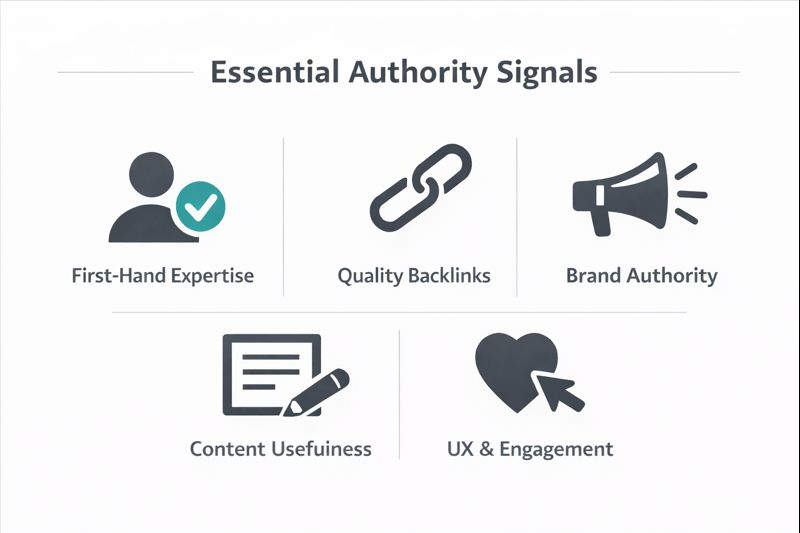
AI-Generated Content Saturation
The web is now flooded with AI-generated content. Google's algorithms have adapted by placing even more emphasis on first-hand experience and unique insights. Generic informational content ranks less reliably than it did 18 months ago. The solution isn't to avoid AI tools, it's to use them strategically while ensuring your content demonstrates genuine expertise and provides value that AI alone can't replicate. If your content could have been written by someone who's never worked in your industry, it won't compete in 2026.
Google’s helpful content guidance
EEAT & Brand Signals
Google's focus on Experience, Expertise, Authoritativeness, and Trustworthiness has intensified. For commercial and YMYL (Your Money or Your Life) topics, brand signals now significantly impact rankings. This means that SEO increasingly overlaps with brand building. Businesses that exist only online with no real-world presence or third-party mentions face steeper ranking challenges. Your SEO strategy needs to include building genuine brand recognition, not just optimising isolated web pages.
Why Backlinks Still Matter
Despite recurring predictions of their demise, backlinks remain a core ranking factor. What's changed is that quality matters exponentially more than quantity. A single link from a genuinely relevant, authoritative source in your industry carries more weight than dozens of links from generic directories or low-quality guest post sites. We've seen Australian businesses overtake competitors with larger link profiles by securing just a handful of high-quality, contextually relevant links.
More info on Links
Why "AI SEO Hacks" Fail Without Fundamentals
There's no shortage of tools promising to automate SEO or shortcuts claiming to game the algorithm. These consistently fail because they ignore fundamentals. AI can help you work faster, but it can't fix a poorly structured site, generate links from authoritative sources, or create content that demonstrates genuine expertise. The businesses winning in SEO in 2025 are those combining strategic thinking with proper execution across all aspects of the framework, not those chasing the latest hack.
SEO for Australian Businesses (Local vs National)
The right SEO approach depends heavily on your business model and target market. Australian businesses generally fall into three categories, each requiring different strategies.
Local Service Businesses
If you serve customers in specific geographic areas, plumbers, electricians, lawyers, medical practices, your SEO strategy centres on local pack rankings and location-specific searches. This requires optimising your Google Business Profile, building local citations, generating authentic reviews, and creating location-specific content that demonstrates your connection to the communities you serve. The competitive dynamics vary dramatically by location. SEO services in Adelaide face different challenges than SEO services in Sydney or Melbourne. A local business in Adelaide competing for visibility needs a strategy built around local relevance, not just generic best practices. Local SEO is often more accessible for small businesses than national SEO, but it still requires methodical execution from an experienced SEO expert in your market who understands regional nuances.
National Brands
Businesses serving customers across Australia face different challenges. You're competing against established brands with larger budgets and stronger domain authority. Success requires excellence across the entire SEO framework, particularly in technical execution and authority building. National SEO also demands sophisticated keyword strategy that accounts for regional search variations across Australia while maintaining a cohesive site structure. The timeline for results is longer, but the payoff is sustained visibility across a much larger market.
Niche B2B and Training Providers
Specialised B2B businesses and training providers occupy a unique middle ground. You might serve clients nationally or even internationally, but you're operating in a relatively narrow niche. This creates both opportunities and challenges. The opportunity is that competition is often less intense than in broad consumer markets. The challenge is that search volumes are lower and the buying cycle is longer, requiring content that addresses multiple stages of consideration. We've helped clients in this category achieve dominant rankings that generate consistent qualified leads by focusing on comprehensive topic coverage rather than chasing high-volume keywords.
SEO Case Examples (Without the Fluff)
Real SEO performance is best illustrated through actual results. While we maintain client confidentiality, we can share anonymised examples that demonstrate how strategy translates to outcomes.
National Training Provider: Sustained Inbound Leads
A client in the vocational training sector came to us ranking poorly for core service terms despite having quality course offerings. Their site architecture scattered related courses across disconnected pages, their technical foundation had indexation issues, and they had minimal authoritative backlinks in the education sector. We rebuilt their information architecture around clear course categories, fixed technical barriers preventing Google from properly crawling the site, and developed a content strategy demonstrating genuine educational expertise. Within eight months, they achieved first-page rankings for all primary course-related searches. More importantly, they now generate consistent qualified leads without paid advertising, something that had seemed impossible previously. View SEO Results
Service Business: Low Competition Doesn't Mean Easy
Another client assumed that operating in a relatively low-competition niche meant SEO would be straightforward. They discovered that low competition often correlates with low search volume, and that capturing the available searches requires the same level of technical and strategic excellence as any other SEO campaign. We needed to expand beyond obvious head terms to capture the full range of ways potential customers searched for their services. By mapping complete search intent and creating comprehensive content across the entire customer journey, we helped them capture a dominant share of available search traffic in their niche. The lesson is that niche SEO requires strategic thinking, not just basic execution.
When Strong Execution Overcomes Newer Domains
We've helped businesses with relatively new websites outrank competitors with decade-old domains and larger link profiles. The differentiator was comprehensive execution across all framework elements. When you properly align technical foundations, create genuinely valuable content, build strategic authority, and optimise for conversion, you can overcome domain age disadvantages faster than most businesses expect. This reinforces that modern SEO is about coordinated excellence, not any single factor.
SEO That Drives Revenue (Not Just Traffic)
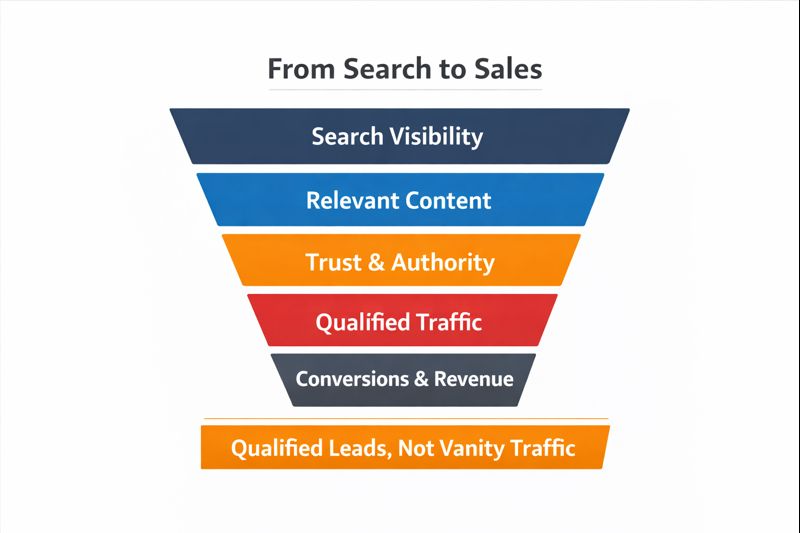
The ultimate measure of SEO success is business impact, not rankings or traffic volume. Converting search visibility into revenue requires connecting SEO to the complete customer experience.
User Experience Directly Impacts SEO Performance
Google's algorithms increasingly reward sites that provide excellent user experiences. This isn't coincidental—pages that users engage with naturally earn better ranking signals. But the relationship runs deeper. If your SEO drives traffic to pages with poor UX, high bounce rates signal to Google that your page doesn't satisfy search intent, gradually eroding your rankings. Conversely, pages that engage visitors create positive user signals that reinforce and strengthen rankings over time. Your SEO and UX strategies cannot be separated.
Conversion Paths Must Match Search Intent
Someone searching "how does SEO work" requires a different conversion path than someone searching "SEO agency Sydney." The first person is in learning mode, potentially months from a purchase decision. Aggressive conversion tactics will drive them away. The second person has clear commercial intent and expects to find service information, pricing indicators, and contact options immediately. Your conversion strategy needs to match where visitors are in their journey, which means mapping conversion paths to specific search intents rather than using one-size-fits-all CTAs.
Lead Quality Matters More Than Lead Quantity
We've seen businesses sabotage their own success by optimising for maximum leads without considering lead quality. Ranking for broad, informational terms might generate impressive traffic numbers and form submissions, but if those leads don't match your ideal customer profile, you're wasting sales team resources and distorting your understanding of SEO ROI. Strategic SEO focuses on attracting qualified prospects, even if that means lower overall traffic. Ten qualified leads are worth more than a hundred unqualified ones.
Sales Attribution Completes the Picture
SEO typically plays a role across multiple customer touchpoints before conversion. Someone might discover you through an informational search, return later through a branded search, and convert after a third visit. Without proper attribution, businesses undervalue SEO's contribution to revenue. We help clients implement tracking that accurately attributes revenue to SEO, even in complex B2B sales cycles with long consideration periods. This data informs smarter strategy decisions and justifies continued SEO investment.
When SEO Is Not the Right Channel
Honest advice about when SEO doesn't make sense builds more trust than promising results in inappropriate situations. Here are scenarios where SEO is not the right primary channel.
New Businesses Without Offer Clarity
If you're still figuring out your core offering, ideal customer, or value proposition, SEO is premature. You need rapid feedback loops and testing, which paid channels provide more effectively. SEO requires commitment to specific keywords and content strategies that reflect clear positioning. Build that clarity first through faster channels, then invest in SEO once you understand what actually resonates with customers.
Low Margin Businesses
SEO is an investment that compounds over time, but it requires sustained investment before generating returns. If your profit margins are thin, the timeline to ROI might not work with your business model. A local service business with 50-60% margins can absorb the 6-12 month investment period for SEO to generate meaningful results. A business operating on 10-15% margins may find that paid channels with immediate returns make more financial sense, even if the long-term economics of SEO are superior.
No Conversion Tracking or Attribution
If you can't measure what happens after someone lands on your site from search, you can't optimise SEO effectively or calculate ROI accurately. Investing in SEO without proper analytics and conversion tracking is like running a business without accounting. You might be successful, but you won't know why or how to improve. Fix your measurement infrastructure before scaling SEO investment.
Markets with No Search Demand
Some products and services face genuine lack of search demand, either because customers don't know the solution exists yet or because buying happens through completely different channels. In these cases, SEO can support broader marketing efforts but shouldn't be your primary channel. Content marketing, PR, or direct outreach may be more effective ways to create awareness and generate demand.
Choosing the Right SEO Agency in Australia
If you've decided SEO is right for your business, choosing the right agency partner determines whether you achieve results or waste budget. Here's what to evaluate.
What to Ask Prospective Agencies
Ask how they've achieved results in competitive markets, not just whether they've achieved results. Anyone can rank content in low-competition spaces. Ask about their technical SEO process, because this reveals whether they understand foundations or just content and links. Ask how they measure success beyond rankings. Ask what didn't work in previous campaigns and what they learned. Agencies that only share successes lack real-world experience. Ask about their team structure and who will actually work on your account, not just who's in the sales meeting. If you're looking for Adelaide SEO services specifically, ask whether they understand the local market dynamics and have experience working with South Australian businesses. An SEO firm in Adelaide should demonstrate knowledge of regional competitors and local search behaviour patterns, not just apply generic national strategies.
Red Flags
Be wary of guaranteed rankings—no one can guarantee rankings because no one controls Google's algorithm. Be suspicious of extremely low pricing—quality SEO requires skilled labour across multiple disciplines. Walk away from agencies that won't explain their link building approach or that promise hundreds of backlinks quickly. Avoid agencies that focus entirely on reporting without tying metrics to business outcomes. Question agencies that claim proprietary connections with Google or special algorithm knowledge.
Pricing Reality
Professional SEO for competitive Australian markets typically requires monthly investment in the range of $3,000 to $10,000+, depending on market competitiveness and scope. This covers strategy, technical optimisation, content development, authority building, and ongoing optimisation. Cheaper options exist but usually deliver cheaper results. More expensive doesn't always mean better, but pricing well below market rates signals corners being cut somewhere. Whether you're comparing SEO service providers nationally or looking at local SEO options specifically, this pricing reality holds true. SEO is fundamentally a skilled labour business—there are no economies of scale that allow agencies to deliver quality work for dramatically less than competitors. When evaluating different SEO services, focus on the methodology and track record rather than just comparing prices.
Timeline Expectations
SEO is not a quick win channel. Expect 3-6 months before seeing meaningful ranking improvements in competitive markets. Expect 6-12 months before SEO generates substantial qualified leads. Businesses that need faster results should combine SEO with paid channels that deliver immediately. The advantage of SEO's longer timeline is that results compound and persist, unlike paid channels where visibility stops when spending stops. Set expectations properly from the start to avoid disappointment.
SEO Built Around Outcomes, Not Reports
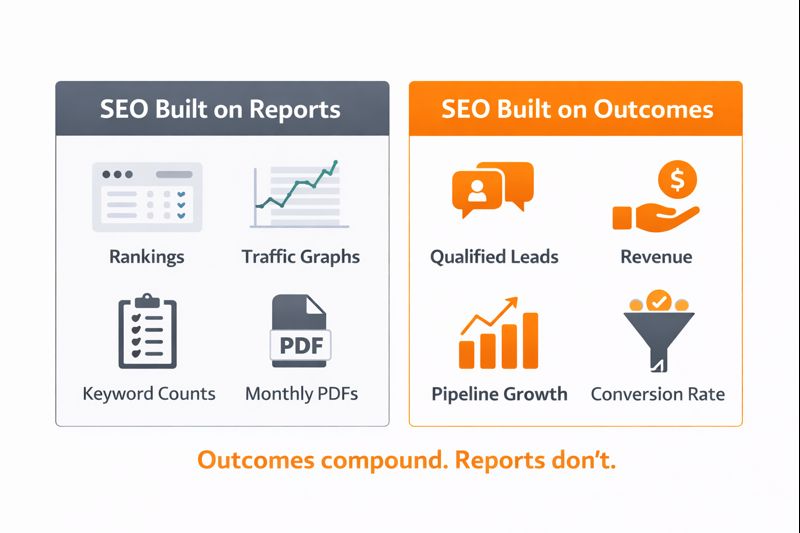
If you want SEO that focuses on business results rather than vanity metrics, Strike Media specialises in strategies designed to compound over time. As an Adelaide-based agency, we work with South Australian and national businesses that understand SEO is an investment in sustainable growth, not a quick fix.
We don't promise overnight results or guaranteed rankings. We do promise strategic thinking, comprehensive execution, and transparent reporting that connects our work to your business outcomes. Our approach to SEO services focuses on the complete framework outlined above—technical excellence, strategic content, genuine authority building, and conversion optimisation working together.
Ready to discuss an SEO strategy built for your specific situation? Explore our SEO services in Adelaide or get in touch with Strike Media to talk through what's possible for your business.